
Optics and Watts: Tracking AI's data center power and fiber connectivity needs
Behind the meter (BTM) generation, CPO switches, fiber supply deals, and the infrastructure race for the gigawatt campus

Bottom Line Up Front
Power availability is currently the primary variable driving and constraining data center development. All signs point to the same conclusion: the grid cannot absorb the load that hyperscalers, neoclouds, and colocation operators plan to connect over the next three to five years. In the US, PJM’s emergency authority to curtail data center power during hot weather (May 28) is the most direct expression of that tension. The NextEra-Dominion merger, FERC’s fast-track interconnection approval, and KKR’s Helix Digital Infrastructure launch all represent different actors responding to the same bottleneck, whether by consolidating grid assets, accelerating queue clearance, or building power supply before committing to a data center site.
The behind-the-meter response to this perceived power “shortage” is scaling fast. Google and Intersect Power broke ground on a 1GW+ colocated data center and energy campus in Texas. VoltaGrid raised $1B from Blackstone and Halliburton for mobile BTM gas turbine systems. DigitalBridge acquired energy investor ArcLight Capital for $1B. These moves reflect the reality that operators who wait for utility interconnection are accepting multi-year delays, while those who control their own generation are accelerating development timelines.
Power may be a central constraint, but fiber connectivity is a close second. Corning is once again at the center of some major new buildout announcements, as it was during the dotcom bubble ~27 years ago. Amazon signed a multibillion-dollar fiber supply agreement in May; NVIDIA followed with a 10x US capacity expansion commitment in June. Earlier this year, Meta and Corning signed a multi-year deal worth up to $6B. At the same time, co-packaged optics are moving from lab to field, as MTN Consulting discussed in its OFC recap. Lambda gave the first external look at NVIDIA’s liquid-cooled Quantum-X CPO switch, Lightmatter launched the Guide DR CPO NIC, and Arista entered the 1.6T switching race with an AI-centric platform. Outside of optics, data center cooling remains a target for venture capital and product innovation. Liquid cooling specialist ZutaCore raised $100m Series C, and Nidec unveiled a 300kW in-rack CDU targeting full-density Blackwell deployments.
Over the last few weeks, US-based hyperscalers have attracted the most attention due to their aggressive capex targets. However, Asia-Pacific is making more noise as well: DayOne ($4.5B Series C financing), AirTrunk-Maharashtra ($21B letter of intent), BDx-PLN (1.2GW utility agreement), and Meta-Reliance Gujarat (168MW) collectively represent more than $25B in announced commitments across the region. And then there is China, Asia’s biggest data center market and a close second to the US in the AI model race. This week, Chinese AI model maker Zhipu released GLM-5.2, offering prices about 1/10 that of Anthropic for a similar performance; over the last few weeks, both Huawei and Alibaba have announced significant enhancements to their own proprietary data center chips. Readier access to local supply will accelerate Chinese data center spending and AI model development. Tencent confirmed this connection in its 1Q26 earnings call, when CEO Huateng Ma said that in 2026 analysts should “…expect a substantial increase in CapEx, especially in the second half of this year as more China designed ASICs become available to us month by month through the year.”
This issue of “Optics and Watts”, published by MTN Consulting’s Silicon Silk Road, is focused on market developments globally from 1 May 2026 through 15 June 2026.
Signal vs. Noise
Below is a summary of recent data center power and connectivity developments, our views on why they matter, and their implications for key players.
15-Jun-26
Zhipu AI open-sources GLM-5.2 as US export controls cut access to Anthropic models
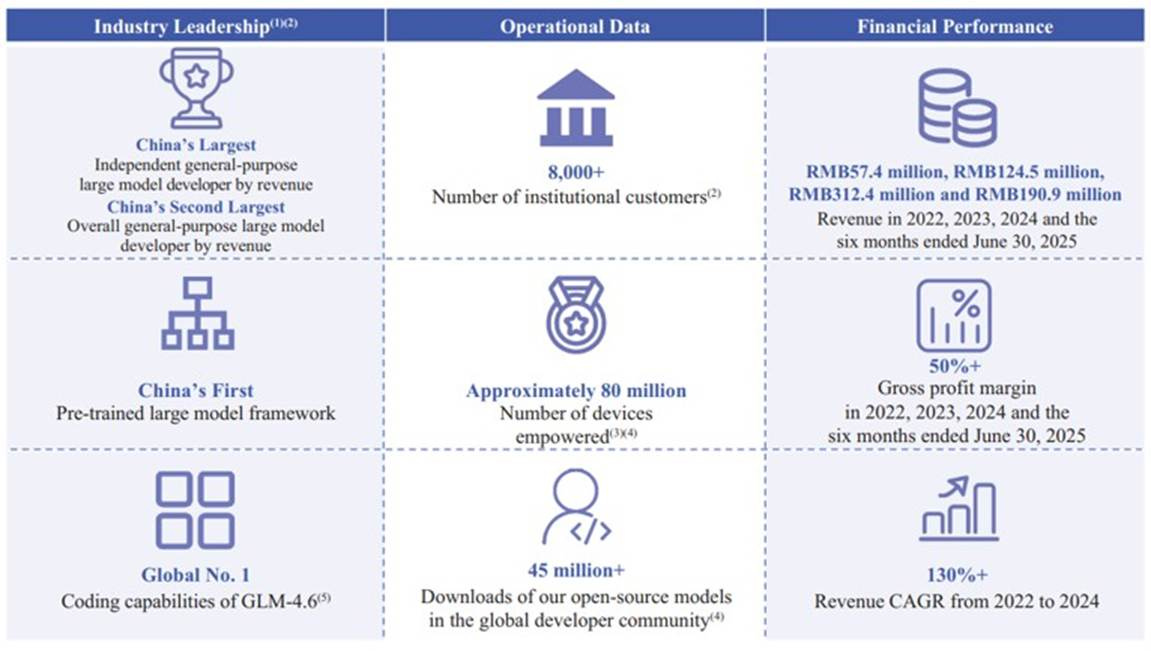
Zhipu AI (Hong Kong-listed as Knowledge Atlas Technology) released GLM-5.2, its latest large language model with a 1-million-token context window, and announced it will be open-sourced under the MIT license later that week. Shares closed up 32.8% at HK$1,457 on June 15, having surged as much as 48% intraday. The stock has risen approximately 820% since Zhipu’s HK IPO in early January 2026. The launch coincided with Anthropic suspending access to its flagship models, Fable-5 and Mythos-5, following a US government export control directive citing national security. GLM-5.2 is available via Zhipu’s GLM Coding Plan subscription at approximately one-tenth the cost of Anthropic’s Claude Code and Claude Max tiers. The GLM-5.2 API was scheduled to go live the week of June 15.
Why it matters
Zhipu’s MIT-licensed open-source release arrives precisely as a US export control directive eliminates Chinese enterprise access to Anthropic’s flagship models. The gap created by Anthropic’s suspension gives Chinese AI developers an opening to capture enterprise users locked out of Western models, and the 10x price discount removes the primary commercial objection for buyers already evaluating domestic alternatives. Intensifying Chinese AI model competition directly supports continued data center investment by Chinese AI companies and hyperscalers. Open-source release under the MIT license also accelerates third-party fine-tuning and deployment, widening the installed base without requiring Zhipu to build all the distribution infrastructure itself.
Source: https://www.scmp.com/tech/tech-trends/article/3357115/zhipu-ais-stock-rockets-after-chinese-firm-makes-glm-52-open-source
12-Jun-26
KKR launches Helix Digital Infrastructure for hyperscale data centers with secured power
KKR launched Helix Digital Infrastructure, a new platform company focused on developing hyperscale data centers with pre-secured power supply. Helix is designed to address the interconnection queue bottleneck by acquiring or contracting power generation capacity before breaking ground on data center facilities. Capital deployment figures, initial project pipeline, and geographic targets were not disclosed at launch.
Why it matters
KKR joining the power-first data center development model reflects the degree to which power availability has become the primary site selection variable for hyperscale customers. KKR already has significant data center holdings and substantial energy infrastructure investments; Helix vertically integrates those two capabilities into a single platform. For hyperscalers shopping for powered-shell capacity in markets with tight interconnection queues, Helix offers a potentially faster path to operational capacity than grid-dependent developers. The key question is whether KKR can secure power at costs competitive with what hyperscalers can procure themselves.
Source: https://w.media/kkr-and-global-investment-partners-launch-helix-a-us-10-billion-ai-infrastructure-company/
10-Jun-26
Amazon secures $17.5B loan for AI data center buildout
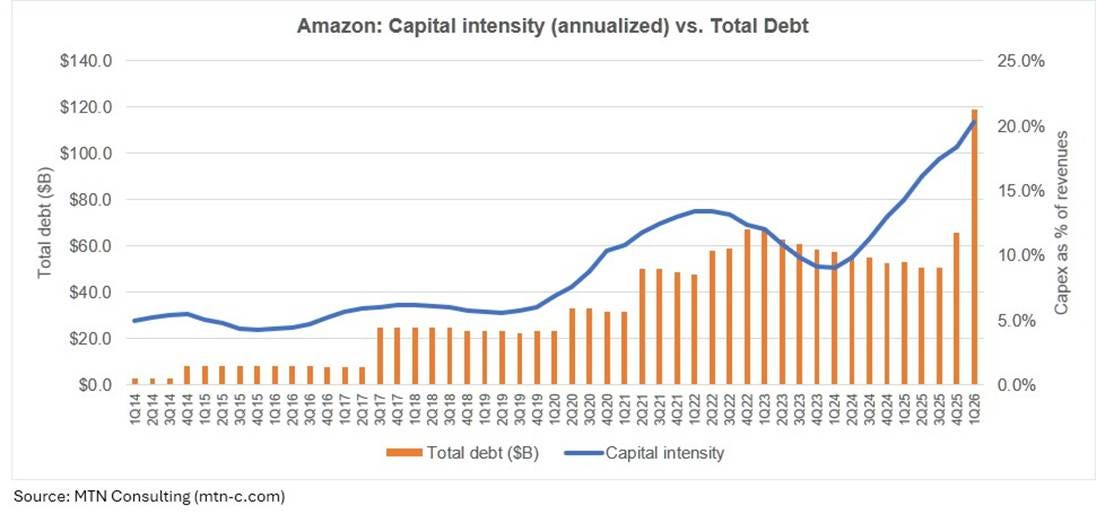
Amazon entered into a $17.5 billion delayed-draw term loan credit agreement with a financial syndicate led by Citigroup to fund AI infrastructure and cloud computing expansion. The agreement allows Amazon to draw capital in tranches through September 2026, with each draw carrying a three-year repayment term. Interest rates are structured at the Secured Overnight Financing Rate plus a spread of 0.625 to 0.875 percentage points based on credit ratings. This borrowing reflects an industry trend where hyperscalers have issued $159 billion in corporate bonds this year to meet rising data center construction demands. As the figure below shows, Amazon’s debt exposure has climbed rapidly in the last couple of quarters as the company’s capex has exploded.
Why it matters
This loan marks a shift in Amazon’s financing strategy for its cloud division, Amazon Web Services (AWS), as infrastructure costs outpace regular cash generation. Bank of America predicts that capex for major cloud providers will reach 100% of operating cash flow by the end of 2026; it hit 100% for Amazon in 1Q26, on an annualized basis. By using a delayed-draw structure, Amazon can access immediate cash in tranches through September 2026 without paying immediate interest on the full $17.5 billion. However, this relies on a highly interconnected network: Google and Amazon are investing heavily in specific AI firms like Anthropic and SpaceX, which then sign long-term data center and computing capacity contracts back with those same hyperscalers. This circular funding model exposes Amazon to broader market risks, making its heavy infrastructure investments vulnerable if these partner companies fail to generate projected revenues or if the Federal Reserve raises interest rates.
Source: https://finance.biggo.com/news/lDYJsp4BrAZSr0oSoRQw//
11-Jun-26
FERC approves PJM fast-track interconnection for large power projects
The US Federal Energy Regulatory Commission (FERC) approved a fast-track interconnection process for large power generation projects connecting to the PJM grid. The reform creates an expedited pathway for projects above a defined capacity threshold to move through the interconnection queue more quickly than under standard review. The approval is intended to accelerate the connection of new generation capacity, including projects serving data center load, to the PJM transmission system.
Why it matters
PJM’s interconnection queue currently holds more than 2,000 projects representing hundreds of gigawatts of proposed generation capacity, with study timelines extending 5-7 years for complex projects. A fast-track process that materially compresses that timeline could unlock new generation capacity serving the Northern Virginia and broader PJM data center corridor much faster. For data center operators and behind the meter (BTM) power developers, the key question is whether the fast-track process applies to generation projects co-located with or dedicated to data center load. This is one of the most important regulatory developments for data center power access in 2026.
Source: https://www.datacenterdynamics.com/en/news/ferc-approves-pjm-fast-track-interconnection-for-large-power-projects/
11-Jun-26
Vodafone Greece and PPC Group propose 50:50 FTTH fiber joint venture
Vodafone Greece and PPC Group (Public Power Corporation, Greece’s largest electricity supplier) announced a proposed 50:50 joint venture to combine their FTTH fiber networks and wholesale fiber businesses in Greece. Combined coverage exceeds 1.6 million homes. PPC FiberGrid currently has 1.88 million homes passed and 1.1 million ready for service; Vodafone’s FTTH network covers 550,000+ homes and businesses. The JV will operate as an open-access wholesale provider to ISPs in Greece. PPC Group serves 8.5 million electricity customers, generates approximately 32TWh, and also operates in Romania and North Macedonia. The transaction is subject to regulatory approval. CEO Achilleas Kanaris (Vodafone Greece): “strategic investment that will substantially accelerate the development of our fiber optic network.”
Why it matters
The JV structure — a telco fiber network combining with a national utility’s fiber infrastructure — is a cost-sharing template with broader European relevance. Open-access wholesale fiber JVs allow both parties to reduce capex duplication while giving ISPs a single network to build on. For data center operators considering Greek market entry, accelerated residential fiber penetration improves the backhaul infrastructure that data centers rely on for connectivity. PPC’s dual role as electricity supplier and fiber infrastructure owner gives the JV unusual leverage: it can offer a co-tenanting proposition across both connectivity and power access that a pure-play telco cannot. Greece’s position as a subsea cable landing hub in the Eastern Mediterranean adds another reason to watch fiber infrastructure investment in this market.
Source: https://www.datacenterdynamics.com/en/news/vodafone-greece-and-ppc-group-propose-greek-fiber-jv/
10-Jun-26
Oracle Cloud Infrastructure revenue up 93%; company raises capex outlook
Oracle reported Oracle Cloud Infrastructure (OCI) revenue growth of 93% year-over-year in its most recent quarter, driven by AI workload demand. Alongside the revenue announcement, Oracle increased its capital expenditure outlook, reflecting accelerating investment in data center capacity. Capex in FY2026 was $55.6B, and is expected to increase in FY2027 to between $90 and $95 billion.
Why it matters
Oracle was bullish in presenting its 93% cloud infrastructure revenue growth metric. If credible, the datapoint suggest that enterprise customers are choosing OCI for AI workloads at a rate that is surprising even Oracle. The circular financing and sustainability of all of this remain open questions. Nonetheless, the capex escalation has direct implications for data center construction pipelines, power procurement, and connectivity demand in Oracle’s primary markets. For suppliers to Oracle’s data center buildout, the revenue trajectory gives confidence that Oracle’s infrastructure commitments will convert to actual procurement. Oracle’s strategy of building dedicated AI regions for large customers is generating a distinctive demand pattern: large, concentrated, customer-specific deployments rather than the distributed footprint typical of AWS or Azure.
Source: https://www.markets.com/analysis/oracle-q4-fy2026-earnings-analysis/
10-Jun-26
Meta secures 168MW at new Reliance Industries data center in Gujarat
Meta signed an agreement for 168MW of data center space at a new Reliance Industries data center campus in Gujarat, India. The agreement marks Meta’s first colocation commitment in India and one of the largest single hyperscaler colocation deals in the country to date. Reliance Jio’s parent company, Reliance Industries, is building the facility as part of its expansion into data center infrastructure. Commercial terms, contract duration, and facility operational timeline were not disclosed. As part of the partnership, Meta is leasing capacity at Reliance’s new Jamnagar facility, which the companies said will be powered by renewable energy and cooled using desalinated seawater. The figure below shows Meta’s historic commitment to renewable energy; it’s currently unclear if this will continue.
